
Vietnam’s semiconductor industry is entering a new phase in 2026. After years of attracting electronics assembly and semiconductor packaging and testing projects, the country is increasingly moving toward a broader ecosystem that includes chip design, prototyping, advanced packaging, testing, semiconductor manufacturing, engineering services and supporting industries.
The Vietnam semiconductor market is also benefiting from several global trends at the same time: rising AI infrastructure investment, growing demand for memory and advanced computing, diversification of semiconductor supply chains, and increasing demand for manufacturing locations across Southeast Asia.
The scale of the opportunity is reflected in Vietnam’s 2026 national semiconductor development targets. The government’s 2026 action plan targets semiconductor industry revenue of more than US$23 billion, domestic value added above 10%, at least 75 chip-design companies, more than 15,000 semiconductor engineers and graduates, and additional investment in semiconductor manufacturing, packaging and testing.
At the same time, the market faces significant challenges. Vietnam must continue developing highly skilled talent, infrastructure, local suppliers, advanced technologies and stronger connections between multinational corporations and domestic companies.
This article examines the Vietnam semiconductor market in 2026, including major FDI projects, the country’s position in the global semiconductor supply chain, key opportunities, challenges and implications for electronics and semiconductor businesses.
What Is the Vietnam Semiconductor Market in 2026?
The Vietnam semiconductor market refers to the ecosystem of companies, investments, manufacturing activities, engineering capabilities, research institutions and supporting services involved in semiconductor-related activities in Vietnam.
The ecosystem currently covers several important stages:
- Semiconductor and IC design
- Chip prototyping and MPW services
- Wafer fabrication and semiconductor manufacturing
- Assembly, packaging and testing
- Memory and storage products
- Semiconductor equipment and materials
- Electronics manufacturing
- Embedded systems
- Industrial automation
- AI and data-center infrastructure
- Semiconductor distribution and supply-chain services
Vietnam has historically been stronger in electronics manufacturing and semiconductor back-end activities, particularly assembly, packaging and testing. However, the direction in 2026 is broader.
The government reported that Vietnam’s semiconductor industry generated more than US$21 billion in revenue in 2025, attracted more than US$14 billion of semiconductor-related FDI across more than 240 projects, and had approximately 60 IC design companies supported by more than 7,000 semiconductor design engineers.
In 2026, national policy is increasingly focused on moving from investment attraction alone toward a more connected ecosystem linking research → design → prototyping → manufacturing → packaging → testing → commercialization.
The launch of Vietnam’s National Multi-Project Wafer Coordination Center in January 2026 and the National Semiconductor Chip Prototyping Support Center in June 2026 are examples of this shift.
Why Is Vietnam Becoming Important to the Global Semiconductor Supply Chain?
Several structural factors are contributing to Vietnam’s growing role.
1. Strong Electronics Manufacturing Ecosystem
Vietnam already has a large electronics manufacturing base serving global smartphone, consumer electronics, computing and industrial markets.
This creates demand for:
- Memory
- Microcontrollers
- Power semiconductors
- Sensors
- Connectivity ICs
- Storage
- Display components
- Embedded processors
- PCB assemblies
- Cable and wiring systems
- Semiconductor testing services
A mature electronics ecosystem gives semiconductor companies an established customer and manufacturing base.
2. Supply Chain Diversification
Global semiconductor companies continue to diversify manufacturing and supply-chain locations.
The objective is not necessarily to replace existing semiconductor hubs. Instead, companies are increasingly developing multi-location supply chains to improve resilience, capacity flexibility and geographic diversification.
Vietnam’s location in Southeast Asia, established electronics manufacturing base and expanding industrial infrastructure make it relevant to this strategy.
3. Growing AI and Data Center Demand
The rapid expansion of AI infrastructure is increasing demand for:
- GPUs and accelerators
- High-bandwidth memory
- DRAM
- NAND
- Enterprise SSDs
- Networking ICs
- Advanced packaging
- High-speed connectivity
- Power-management semiconductors
This has broader consequences for the semiconductor supply chain.
For companies operating in Vietnam, the opportunity is therefore not limited to semiconductor fabrication. It also includes memory distribution, server components, PCB assemblies, thermal systems, testing, embedded computing and electronics manufacturing services.
Major Semiconductor FDI Projects in Vietnam
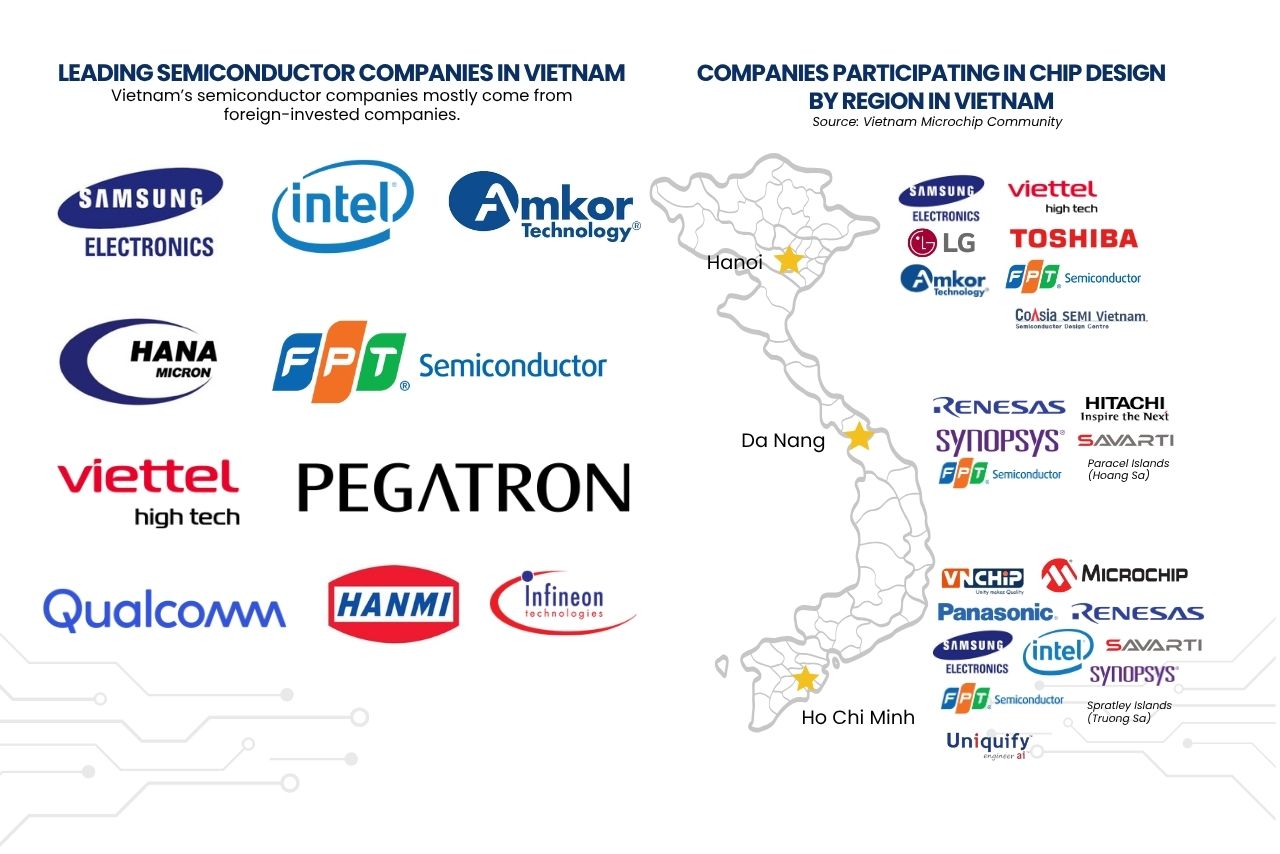
One of the strongest indicators of Vietnam’s semiconductor development is the presence and expansion of major international companies.
Intel Vietnam
Intel has operated its assembly and test facility at Saigon Hi-Tech Park in Ho Chi Minh City for many years.
In 2026, Intel’s Vietnam operations continued to expand their role within the company’s global manufacturing network. Reporting from Vietnam’s investment community indicated that Intel was relocating part of its assembly and testing operations from Costa Rica to Ho Chi Minh City, including products serving data-center and networking applications.
Intel’s Vietnam facility has therefore become more than a conventional electronics manufacturing site. It represents an important semiconductor assembly, packaging and testing capability within the country’s ecosystem.
This creates opportunities for local companies supplying:
- Semiconductor materials
- Manufacturing equipment
- Automation systems
- Test equipment
- Electronic components
- Packaging-related products
- Engineering services
- Industrial infrastructure
Samsung Vietnam
Samsung Electronics is already one of Vietnam’s largest foreign investors.
In May 2026, Reuters reported that Samsung planned a semiconductor testing facility in Vietnam with proposed investment of approximately US$1.5 billion. The facility was reported to be under construction in northern Vietnam and could begin operations in 2027, subject to the relevant approvals.
According to the proposal reviewed by Reuters, the planned facility would have significant capacity for DRAM and NAND testing.
This development is particularly relevant to the Vietnam semiconductor market because it connects Vietnam more directly with the global memory semiconductor supply chain.
It also demonstrates how AI-driven memory demand is influencing investment decisions beyond leading-edge wafer fabrication.
Amkor Vietnam
Amkor Technology has established an advanced semiconductor packaging and testing operation in Bac Ninh.
Amkor describes its Vietnam facility as a smart factory supporting advanced System-in-Package, memory and test technologies, with capabilities extending across parts of the product development and manufacturing chain.
The presence of Amkor is important because advanced packaging is becoming increasingly strategic.
As semiconductor architectures become more complex, performance increasingly depends not only on the transistor process but also on:
- Packaging architecture
- Chiplet integration
- High-density interconnects
- Thermal management
- Memory integration
- High-speed signal integrity
- Advanced testing
This creates opportunities for Vietnam to develop capabilities beyond traditional assembly.
FPT and Domestic Semiconductor Capability
Vietnam’s semiconductor ecosystem is also beginning to involve more domestic companies.
In January 2026, FPT announced an advanced semiconductor testing and packaging plant in Bac Ninh. The first phase was planned for 2026–2027, with ATE testers, handlers, reliability testing, burn-in and failure-analysis capabilities.
The project is significant because it adds locally developed semiconductor packaging and testing capability to the ecosystem.
Vietnam’s strategy is therefore gradually developing from an FDI-centered model toward a combination of:
Global semiconductor companies + Vietnamese technology companies + universities + research institutions + domestic suppliers.
Vietnam’s Semiconductor Supply Chain: Where Does It Compete?
Vietnam should not be viewed as a direct replacement for every semiconductor manufacturing hub.
Instead, its competitive position is developing across specific segments.
| Semiconductor Segment | Vietnam Position in 2026 | Development Direction |
|---|---|---|
| IC Design | Growing | Expand design companies and engineering talent |
| Wafer Fabrication | Early-stage | Develop strategic domestic manufacturing capability |
| Chip Prototyping | Developing | Build shared infrastructure and MPW capability |
| Packaging | Established and expanding | Move toward advanced packaging |
| Testing | Strong and expanding | Increase advanced testing capability |
| Memory | Strong downstream ecosystem | Expand testing, packaging and distribution |
| Electronics Manufacturing | Highly developed | Move toward higher-value products |
| EMS | Established | Increase automation and engineering content |
| Semiconductor Equipment | Developing | Build supporting supplier ecosystem |
| Semiconductor Materials | Developing | Increase local supply capability |
This structure is important for businesses evaluating the Vietnam semiconductor market.
The opportunity is not limited to building a wafer fab.
There are also opportunities in the surrounding ecosystem.
Key Opportunities in the Vietnam Semiconductor Market 2026
1. Semiconductor Packaging and Testing
Packaging and testing are among Vietnam’s most established semiconductor capabilities.
The expansion of Intel, Amkor, Samsung and domestic projects such as FPT’s facility indicates continued development of this segment.
Future opportunities include:
- Advanced packaging
- System-in-Package
- Memory packaging
- Automotive semiconductor testing
- Reliability testing
- Failure analysis
- Burn-in testing
- Automated test equipment
- Semiconductor inspection
As AI and high-performance computing increase semiconductor complexity, advanced packaging and testing are expected to become increasingly important parts of the value chain.
2. IC Design and Semiconductor Engineering
Vietnam has a growing engineering workforce and an expanding number of IC design companies.
The 2026 national plan targets at least 75 semiconductor design enterprises and more than 15,000 semiconductor engineers and graduates.
This creates opportunities in:
- ASIC design
- SoC development
- Analog IC
- Digital IC
- Embedded systems
- Verification
- Physical design
- Firmware
- Semiconductor IP
- EDA engineering
The challenge is not simply increasing the number of engineers.
Vietnam must also develop engineers capable of working on increasingly complex international semiconductor projects.
3. Semiconductor Prototyping
One of the notable developments in 2026 is the creation of national infrastructure supporting semiconductor prototyping.
The National Semiconductor Chip Prototyping Support Center was officially launched in June 2026.
The center is designed to support activities spanning chip design, prototyping, packaging, testing and commercialization while connecting domestic projects with manufacturing and testing resources.
This can reduce barriers for:
- Universities
- Startups
- IC design companies
- Research institutions
- Domestic technology companies
It also creates a bridge between semiconductor research and commercial product development.
4. Memory and Storage Supply Chain
Memory is becoming particularly important because of AI infrastructure.
AI servers require large quantities of:
- HBM
- DDR5
- LPDDR5X
- Enterprise SSD
- NAND Flash
- High-capacity storage
Vietnam’s growing role in memory testing and electronics manufacturing creates opportunities for semiconductor distributors and component suppliers.
For companies such as Pionix, this ecosystem connects directly with:
- DRAM
- NAND Flash
- eMMC
- UFS
- SSD
- DIMM
- SD Card
- Embedded storage
- Server memory
The opportunity extends beyond component sales into technical sourcing, lifecycle management, product qualification and system-level support.
5. AI Infrastructure and Data Centers
The growth of AI infrastructure is creating a new semiconductor demand center in Vietnam.
AI data centers require a combination of:
- GPU and accelerator platforms
- HBM
- DDR5 server memory
- Enterprise SSD
- Networking
- Power management
- Thermal management
- High-speed interconnects
- Storage systems
- Embedded controllers
This means the development of Vietnam’s AI infrastructure can create additional demand for semiconductor components and server technologies.
For the broader electronics industry, AI infrastructure also creates opportunities in:
server manufacturing → memory → storage → PCB → power → cooling → networking → automation.
6. Electronics and EMS Supply Chain
Vietnam’s semiconductor development is closely connected with its electronics manufacturing sector.
The country already has a large manufacturing base, and the next development stage is likely to involve increasing local participation in:
- PCB assembly
- Box-build manufacturing
- Testing
- Industrial automation
- Product integration
- Wiring harness
- Embedded systems
- Component sourcing
- Engineering services
This is where EMS and semiconductor supply chains overlap.
An electronics manufacturer does not necessarily need to manufacture semiconductor wafers to participate in the semiconductor ecosystem.
It can create value through engineering, assembly, testing, integration and supply-chain services.
7. Domestic Supplier Development
A major focus of Vietnam’s 2026 FDI policy is strengthening connections between foreign-invested companies and Vietnamese suppliers.
The government’s 2026–2030 FDI strategy explicitly identifies electronics, semiconductors, AI, data, cloud computing and advanced technologies as priority investment areas. It also calls for stronger domestic supplier development and deeper participation of Vietnamese companies in global value chains.
For local companies, this creates opportunities to become qualified suppliers for multinational corporations.
However, supplier qualification requires more than competitive pricing.
Companies increasingly need:
- Quality management systems
- Traceability
- Technical documentation
- Stable supply
- Production capacity
- Engineering support
- Compliance
- Lifecycle management
- International certifications
Challenges Facing the Vietnam Semiconductor Market
Despite strong momentum, Vietnam still faces several structural challenges.
1. Shortage of Advanced Semiconductor Talent
The semiconductor industry requires specialized engineers across multiple disciplines.
Vietnam has expanded university programs and workforce development, but the industry’s growth rate can create additional demand for experienced engineers.
The challenge is therefore both quantity and quality.
Priority areas include:
- IC design
- Semiconductor process engineering
- Advanced packaging
- Test engineering
- Reliability engineering
- EDA
- AI hardware
- High-speed electronics
- Semiconductor equipment
2. Limited Domestic Value Added
A large portion of Vietnam’s electronics exports is still generated by foreign-invested companies.
This means that increasing export value alone does not automatically translate into equivalent domestic value creation.
The next stage is to increase:
- Vietnamese suppliers
- Local engineering
- Local R&D
- Domestic semiconductor companies
- Supporting industries
- Technology transfer
- Local intellectual property
This is one of the key long-term challenges for the Vietnam semiconductor industry.
3. Infrastructure and Energy Requirements
Semiconductor and advanced electronics manufacturing require reliable infrastructure.
Important requirements include:
- Stable electricity
- Clean water
- Industrial gases
- High-quality logistics
- Data connectivity
- Cleanroom infrastructure
- Environmental management
- Industrial automation
As semiconductor manufacturing becomes more advanced, infrastructure requirements become more demanding.
Vietnam therefore needs to develop industrial infrastructure alongside semiconductor investment.
4. Global Competition
Vietnam is competing with established semiconductor and electronics ecosystems across Asia.
These include major manufacturing centers in:
- Taiwan
- South Korea
- Japan
- China
- Singapore
- Malaysia
Vietnam’s opportunity is therefore not based on cost alone.
Long-term competitiveness will depend increasingly on:
talent + technology + infrastructure + supplier ecosystem + reliability + speed to market.
Vietnam’s Semiconductor Strategy: From FDI to Ecosystem
A significant characteristic of the 2026 market is the transition from simply attracting semiconductor investment toward developing an integrated ecosystem.
The government’s 2026 semiconductor action plan explicitly emphasizes connecting research, application and market, while supporting chip design, prototyping, manufacturing, packaging, testing and commercialization.
The launch of national prototyping infrastructure and multi-project wafer coordination also supports this direction.
This creates a potential development path:
Research → IC Design → Prototyping → Manufacturing → Packaging → Testing → Product Integration → Commercialization
For Vietnam, the objective is not simply to participate in one stage.
The longer-term opportunity is to build stronger connections between all stages.
What Does Vietnam’s Semiconductor Growth Mean for Businesses?
The development of the semiconductor ecosystem creates opportunities for several groups.
Semiconductor Suppliers
Demand may increase for:
- Memory
- NAND Flash
- DRAM
- SSD
- eMMC
- UFS
- Semiconductor ICs
- Sensors
- Power components
Electronics Manufacturers
Opportunities include:
- EMS
- PCB assembly
- Product integration
- Industrial automation
- Testing
- Embedded systems
Technology Companies
Potential areas include:
- AI hardware
- Edge computing
- IoT
- Semiconductor design
- Data centers
- Embedded platforms
Local Supporting Industries
Potential opportunities include:
- Semiconductor equipment
- Materials
- Packaging
- Logistics
- Engineering services
- Facility management
- Automation
The development of the Vietnam semiconductor market therefore has implications well beyond semiconductor manufacturers themselves.
Pionix and the Vietnam Semiconductor Ecosystem
For Pionix, the development of Vietnam’s semiconductor market creates a strong connection between Memory & Computing, Electronic Components and EMS Solutions.
Pionix can support customers across several parts of the electronics and semiconductor value chain, including:
- DRAM and server memory
- NAND Flash
- eMMC and UFS
- SSD
- DIMM
- SD Card
- Electronic components
- Embedded systems
- EMS manufacturing
- PCB-related solutions
- Industrial applications
- AI and data-center infrastructure
The focus is not simply on component availability.
A modern semiconductor supply chain also requires:
technical selection → sourcing → qualification → supply planning → product lifecycle support.
This becomes particularly important when customers are developing industrial equipment, servers, AI systems, embedded products or long-life electronics.
As Vietnam’s semiconductor ecosystem develops, suppliers with both technical knowledge and supply-chain capability can play an increasingly important role in connecting global semiconductor manufacturers with Vietnamese OEMs, EMS companies and system integrators.
FAQ: Vietnam Semiconductor Market 2026
What is the Vietnam semiconductor market in 2026?
The Vietnam semiconductor market in 2026 includes semiconductor design, prototyping, manufacturing, packaging, testing, electronics manufacturing, component distribution and related engineering services. The ecosystem is expanding from primarily back-end manufacturing toward a broader semiconductor value chain.
How large is Vietnam’s semiconductor industry?
Vietnam’s semiconductor industry generated more than US$21 billion in revenue in 2025, according to Vietnamese government information. The 2026 national plan targets semiconductor industry revenue above US$23 billion.
Which semiconductor companies are investing in Vietnam?
Major international semiconductor and electronics companies with significant operations or investment activity in Vietnam include Intel, Samsung, Amkor and other global technology companies. Domestic companies such as FPT are also developing semiconductor packaging and testing capabilities.
Is Vietnam manufacturing semiconductor chips?
Vietnam participates in several stages of semiconductor manufacturing, particularly assembly, packaging and testing. In 2026, the country is also developing domestic prototyping and semiconductor manufacturing capabilities as part of a broader national ecosystem strategy.
Why is Vietnam attractive for semiconductor investment?
Key factors include Vietnam’s electronics manufacturing ecosystem, skilled engineering workforce, geographic position in Southeast Asia, expanding industrial infrastructure, supply-chain diversification opportunities and government support for semiconductor development.
What are the biggest challenges for Vietnam’s semiconductor industry?
Major challenges include developing advanced semiconductor talent, increasing domestic value added, strengthening supporting industries, improving infrastructure and moving toward higher-value activities such as IC design, advanced packaging and semiconductor R&D.
Will AI increase semiconductor demand in Vietnam?
AI is expected to create additional demand for memory, storage, networking, computing, power and advanced packaging technologies. Vietnam’s growing electronics and data-center ecosystem can therefore benefit from the broader AI semiconductor investment cycle.
What opportunities exist for Vietnamese semiconductor suppliers?
Opportunities include semiconductor components, memory, storage, packaging-related services, testing, PCB assembly, EMS, industrial automation, engineering services and supply-chain support.
Conclusion: Vietnam Semiconductor Market 2026 and the Road Ahead
The Vietnam semiconductor market in 2026 is moving beyond the traditional model of electronics assembly and semiconductor back-end manufacturing.
The country is building capabilities across a wider ecosystem:
IC Design → Prototyping → Manufacturing → Packaging → Testing → Electronics → AI Infrastructure.
Major investments from companies such as Intel, Samsung and Amkor, together with the development of domestic semiconductor projects and national prototyping infrastructure, are strengthening Vietnam’s position within the global semiconductor supply chain.
At the same time, Vietnam’s next challenge is to convert investment into deeper domestic capabilities.
That means developing more semiconductor engineers, increasing local supplier participation, expanding R&D, improving infrastructure and enabling Vietnamese companies to move further up the technology value chain.
For semiconductor distributors, electronics manufacturers, OEMs, EMS providers and technology companies, the development of Vietnam’s semiconductor ecosystem creates opportunities across memory, storage, components, embedded systems, manufacturing and AI infrastructure.
As the market evolves, companies that combine technical capability, reliable sourcing and long-term supply-chain support will become increasingly important to Vietnam’s electronics and semiconductor ecosystem.
Looking for Memory, Storage, Electronic Components or Semiconductor Solutions for your next project?
Pionix International supports OEMs, system integrators, EMS companies and technology businesses with semiconductor and electronic component solutions for industrial, computing, AI, IoT and embedded applications.
Contact Pionix to discuss your project requirements and sourcing needs.